2026-06-26
What Panenco learned using AI in production
Notes from a Panenco event in Leuven: monorepo with design and docs, mock-driven development, CI/CD for small changes, and the job shifting from writing code to reviewing it.
Last week I attended an event at Panenco in Leuven: What we learned using AI in production. They opened up their engineering floor and walked through how AI has changed the way they work. Worth going.
The monorepo as a single source of truth
Panenco runs a monorepo that contains design, code, and product management in one place. Documentation is in Markdown, pulled into the repo alongside the code. Architecture diagrams live there too. Confluence is effectively replaced.
Communication is not yet unified. They still run multiple channels (Slack, email) and acknowledge that as a gap. Getting to monochannel is harder than getting code into a single repo.
Mock-driven, spec-first development
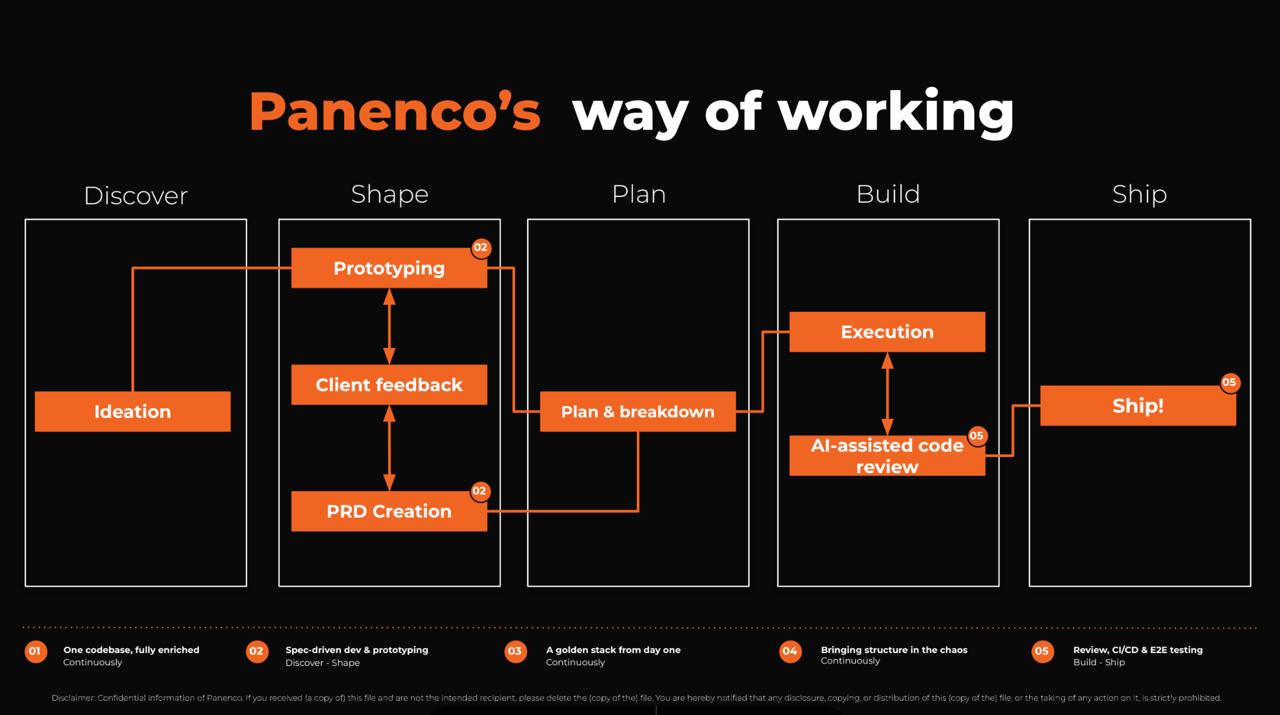
Slide by Panenco, shared with permission.
Figma is being phased out. Instead they work with mock-driven development and iterate on spec sheets with the client. Prototypes are generated from production code, not from a separate design tool. The PRD (Product Requirements Document) is the starting point, and the workflow loops between spec and client feedback before a line of production code is written.
They have a "golden stack" with defined rules and skills. An opinionated way of working, not a free-for-all. The way-of-working slide was good. I need to get that from them.
CI/CD for small changes, automatically
One takeaway I want to pass on to Dieter: small changes go through CI/CD automatically. No manual gatekeeping for routine updates. That is the kind of thing that sounds obvious but is hard to actually implement consistently.
The job has changed
The most direct observation of the evening: the job has shifted from writing code and some planning to mostly planning and a lot of reviewing. Less keyboard time, more thinking time. Some teams have halved in size while the bar for output has gone up.
They are moving toward what you could call forward-deployed engineers: generalist, all-round profiles rather than narrow technical specialists. Engineers who throw code over the wall and walk away are not the right fit anymore.
Tooling: switched from Cursor to Claude Code
Panenco has moved from Cursor to Claude Code, though tooling is still per-person, not unified across the team. Model choice is also left to individual developers. That is a pragmatic position in a market where the best option changes every few months.
They manage their rules file through their own Claude marketplace. A similar approach to what I am building with my no-emdashes skill.
Things mentioned by other attendees
A few tools came up in the room that I want to look into:
- Ponytail: compact code generation
- Headroom: both input and output compression
- And my own no-emdashes skill got a mention
The "Grill me" command
Panenco has a command they call "Grill me" that asks questions one by one until the full design tree is mapped out. Similar to a best-practice prompt I use, but more structured: it keeps asking until there are no open questions left. Worth studying.
Good event. These are the conversations worth having in person. Crowd was young, a good mix of developers and designers. I was probably the oldest or second oldest in the room. Refreshing.
Written with assistance from Dobbie, Frederik's AI assistant.